The Arduino of inverters
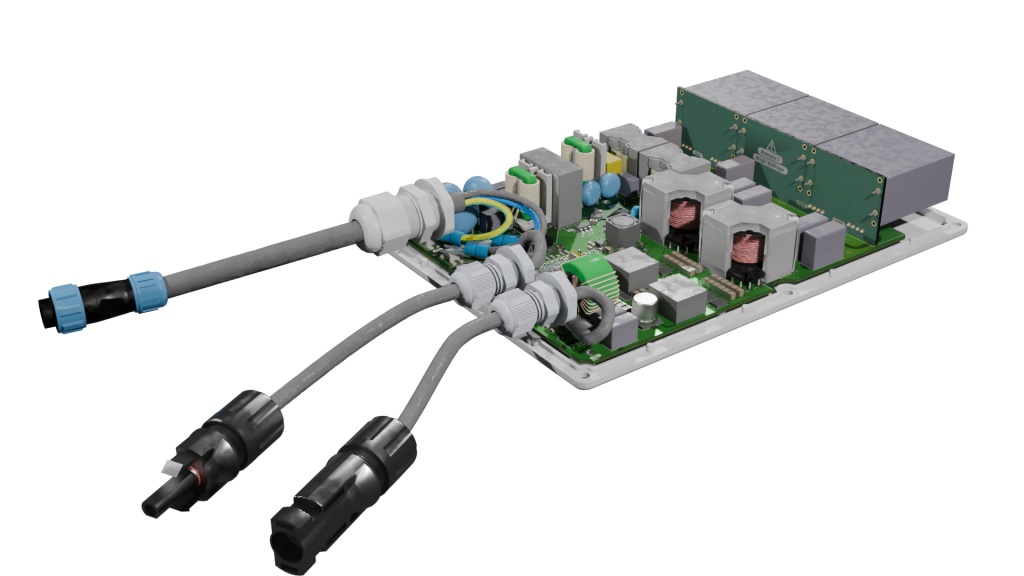
In this interview series, we highlight outstanding open-source hardware projects. The focus is on the experiences of the project teams. This time, we speak with electrical engineer Jean-Alinei, who is working on a microinverter in France with Owntech. The device is oriented on the Arduino design and is intended to be highly customizable via software.
What is OwnTech and who is behind it?
About six years ago, I began working on this topic together with Luiz Villa as part of a research project. Our starting point was the question of how we could use power electronics to better support electrification programs—especially in rural regions. Our focus was on modularity at the hardware level and on so-called software-defined inverters. In other words, systems that have many hardware functions that can be adapted to local conditions through programming.
Especially in the Global South, traditional black-box systems are a major problem: proprietary inverters developed in the Global North. Locally, they often lead to difficulties. For example, when devices fail and cannot be repaired because they are beyond the users’ control. Maintenance then often depends on warranties, which in turn are only available in certain regions. Or the devices simply cannot be transported across borders to be repaired.
Our idea was therefore to design these systems to be open: to make blueprints accessible, enable local maintenance, and thus rethink the products from the ground up. This not only helps with electrification but also has broader social relevance. Electricity plays a central role in decarbonization. As the use of electricity increases — replacing, for example, oil — the demand for power converters also rises. Open source can make an important contribution here. So this is how we came to broaden the focus of the project, not only to tackle rural electrification, but more generally how to leverage software defined power electronics to help accelerate the energy transition.
From the very beginning, we wanted to make the results developed in the research project available as open source and build a community to collaborate on them. This led us to a central question: How do we build trust and structure for contributions from the community? This gave rise to the OwnTech Foundation. The foundation’s goal is to build trust in open-source hardware in the field of power electronics and to promote knowledge and expertise in this area in France and Europe.
In addition, we founded a company of the same name that develops, produces, and distributes open-source hardware. Currently, our focus is primarily on educational institutions, universities, and colleges. Similar to Arduino or Raspberry Pi, we are starting in the academic sector and then gradually expanding the fields of application. We are currently at the point where we are beginning to develop end-user products as well.
With OwnTech, we basically want to create something like an “Arduino” or “Raspberry Pi” for power electronics. Not hardware that was developed once and created for a very specific function, but a platform that can be easily reconfigured via software.
You’ve already said a lot about your mission. I’d like to delve a bit deeper into the target audience: Who did you develop the inverter for?
For us, the microinverter is an ideal starting point for creating an open-source hardware product. In its current design, it’s easy to test. You basically just need a solar panel to try it out at home. It covers many use cases: from balcony power plants to off-grid solutions, such as for greenhouses or remote locations. With about 500 watts of power, many scenarios can already be realized. Additionally, you can combine multiple units if more power is needed.
Our target audience consists primarily of energy enthusiasts—people who are actively engaged with the technology and want to adapt it or integrate it into their own systems, such as home automation. Energy communities are also part of this group. It’s a niche market, but a very engaged audience that’s also willing to contribute to the project.
We wanted to develop a product that serves both a practical purpose and acts as an entry point for participation. That’s why we deliberately started small — not in the megawatt range.
So on one side, the goal is to build the very first open source inverter for energy enthusiasts— and on another side to have a community engaging project where developers can gain confidence with product certification of grid connected appliances, hopefully helping underpinning the question: How do you certify an open source hardware product ?
Good question: How do you certify an open-source project?
With your software-defined approach, you’re pursuing an adaptive design. What do you think of parametric design in this context? Would an inverter be conceivable that can be flexibly adapted to different power ranges?
Let’s first look at how commercial micro-inverters are constructed. There are usually two stages: a DC-DC stage with MPPT functionality and a DC-AC stage that feeds power into the grid.
Many commercial systems combine these stages very closely for cost reasons. This makes them efficient, but also inflexible. They can hardly be modified or expanded, for example for bidirectional use. Batteries also often cannot be integrated unless they are already provided for.
Our approach differs primarily in the topology of the DC-DC stage. We maintain modularity so that multiple DC-DC converters can be combined with a shared DC-AC stage. This allows the power on the input side to be increased, enabling more solar modules to be connected.
Regarding parametric design: Technically, this is conceivable as a simulation-based system that automatically generates designs meeting specific requirements. But that is very complex. From the user’s perspective, it is often not necessary at all. They want products that work, are easy to use, do not require monitoring, and are independent of large cloud systems. Technical developers, on the other hand, need open, well-documented designs they can work with to develop their own solutions.
You mentioned repairability; that’s particularly difficult with electronics. How did you handle that?
That is indeed a major challenge. Open hardware and repairability are closely linked. Without access to technical information, repair is hardly possible. At a systemic level, however, there is a conflict of objectives: robustness versus repairability.
A very robust device is often difficult to repair, for example, if it is completely encapsulated or has a watertight glued or ultrasonic welded housing. Conversely, it is more difficult and expensive to make repairable designs robust.
Regulatory requirements also come into play. Standards prescribe certain clearances and safety measures, which make designs more complex and larger. For instance when not using conformal coating which consists in an extra layer of protective varnish, on top of the electronics, norms imposes extra clearance between components. From a designer perspective, you effectively trade ease of design, and robustness provided by this extra coating, for ease of repairability and overall cost increase.
We have invested significant effort into understanding these standards and strive to develop designs that do not require extra coating. While this leads to higher costs, it improves maintainability.
Another point is this: even if a device is theoretically repairable, it can quickly fail in practice if it is not properly resealed after being opened. So this requires good processes and competent repair technicians to ensure robustness even after the repair. Maintenance network, and local know-how plays a key role in real world conditions.
Finally, user behavior also plays a role: Many devices aren’t replaced because they’re broken, but because they no longer meet the user’s needs. We believe that open source can play a role here. As the product can be adapted for specific needs. Also, it permits updates that are independent from the willingness of a single manufacturer, providing a practical solution to mitigate what is called optional obsolescence, when a old generation device cannot be updated with newer now standard features.
What design decisions have you made?
So far we’ve mostly focused on the developer centric community. How can we ease future development and reuse this first design. For instance we’ve chosen a power arrangement that can be turned into a bidirectional inverter later. The power layout on the DC/DC side is meant to be scalable, in the sense we can parallel more of this standard units to connect more PV panels in future products.
We’ve also opted for a ease of replication — using a standard supplier for all the bill of material, and standard industrial process. The goal here is to limit the friction for newcomers who would like to get started and give a hand to the community.
From a sustainability perspective, we’ve opted for a technical solution that does not include electrolytic capacitors. The capacitor bank is also on a separate PCB, in order to provide ease of replacement when hitting aging limits.
We have tested various approaches. Ultimately, it always comes down to finding the right balance between robustness, repairability, and safety. Now it is time to tell what works and what not. The goal was not to make the perfect design from scratch, but to have a first platform on which we can test and assess a maximum of ideas. Not alone, but as a community.
What are your future plans, and when will the OwnTech inverter be available for purchase?
We’ve an existing product line-up already available for sale, and we are in the process of extending the product catalog with newer products. The micro-inverter is among them and we are currently in the stage of certification, so I cannot yet provide an exact date for when they will be available for purchase, but we hope to be able to deliver by end of 2026.
In addition to micro-inverters, we are also exploring applications in the field of e-mobility, such as drives for cargo bikes or small vehicles. You’ll here from us on that soon !
As an impact driven company our goal is to democratize access to power electronics so we’ll continue to invent, design and distribute open source building blocs to accelerate the energy transition. We believe that in the long term, there will be a network of companies that use, produce, and distribute our open designs, effectively decentralizing the action and impact, as open source is known to do best.